Surface aerosol sprays purchased in retail outlets frequently worsen infestations inside residential structures. Contact insecticides kill only the sterile foraging workers on visible trails, prompting distressed…
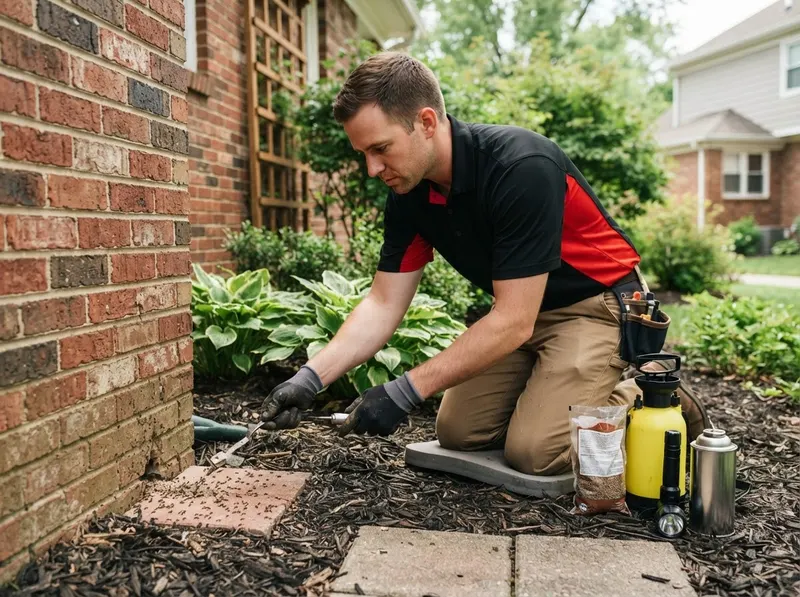
Surface aerosol sprays purchased in retail outlets frequently worsen infestations inside residential structures. Contact insecticides kill only the sterile foraging workers on visible trails, prompting distressed parent nests to execute colony budding, a defensive behavior where single colonies divide into multiple independent satellite nests throughout wall cavities. Sustainable control requires applying transfer-chemistry formulations approved by the U.S. Environmental Protection Agency. Foragers unknowingly transport these undetectable non-repellent compounds back to deep sub-floor and exterior voids, feeding the queen and brood via trophallaxis to collapse the entire population within 14 to 21 days.
Ant behavior in central Ohio tracks regional soil moisture and structural age patterns identified by the Ohio State University Extension. In historic brick foundations across German Village and Victorian Village, pavement ants exploit settling mortar joints and slab penetrations near kitchen plumbing. Meanwhile, properties with established tree canopies in Clintonville, Worthington, and Upper Arlington experience elevated pressures from black carpenter ants (Camponotus pennsylvanicus). These wood-destroying insects excavate structural framing softened by moisture leaks, requiring specialized drill-and-inject protocols that comply with standards published by the National Pest Management Association.
All treatments implemented by StoneLark Insect Control utilize precision gel matrices and perimeter microencapsulated suspensions evaluated for domestic safety by the Centers for Disease Control and Prevention. Active ingredients are placed inside tamper-resistant stations or injected directly behind switch plates and plumbing voids, preventing exposure to household pets or residential landscaping. Following guidelines from the Ohio Department of Agriculture, perimeter treatments are directed strictly to exterior structural perimeters and foundation entry paths to stop migration from nearby vegetation.
Property owners evaluating treatment options balance single-visit topical treatments against comprehensive structural colony eradication. Spot treatments offer lower upfront costs but fail to halt wood degradation caused by hidden satellite nests within joists, under insulation, or beneath roof flashing. Complete colony elimination targets the nesting epicenters documented in pest management manuals from the Purdue University Department of Entomology, providing measurable domestic relief and lasting structural protection without binding homeowners to perpetual monthly contracts.
Every job gets a firm, written price after a free on-site visit.
Tell us about your ant colony elimination job in Columbus and we'll send a clear, written quote, usually the same day.
 StoneLark Insect Control